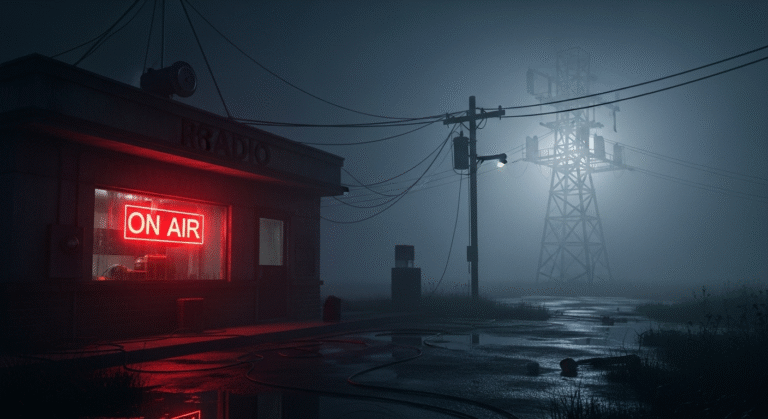
Haunted Radio Operator Job at Station 103.3 FM
Congratulations — you’ve been hired as the overnight radio operator for Station 103.3 FM, a small, forgotten station in the hills just outside of town.Your shift starts at midnight.Your task is simple: keep the music running, monitor the signal, and follow the rules posted above the control board. They look ordinary at first — printed on yellowing paper, corners curled from years of static heat.But by your second night, you’ll understand they aren’t there for show. Rule 1: Never play requests that come from unlisted numbers. The phone rings more often than you expect.Sometimes it’s a trucker passing through, asking for old rock songs to stay awake.Sometimes it’s a lonely voice saying they used to listen “back when the tower was still alive.” But sometimes — too often — it’s a number that doesn’t exist.No caller ID. No area code. Just a blank screen and the faint hum of electricity. If you answer, the line will hiss like ocean static. Then a voice will come through — calm, familiar, almost comforting. “Play it for me,” it says.“The song from before the accident.” You’ll think it’s a prank. You’ll scan your playlist, find nothing that matches.The voice will insist. It always does. If you play anything for that caller, you’ll hear the faint sound of applause on the other end… then silence.Moments later, the studio’s red “ON AIR” light will flicker, and every dial on the console will shift on its own — tuning to a signal that shouldn’t exist. Whatever plays next won’t be from your library. And if you keep listening, you’ll hear your own voice in the background — introducing the next song. Life at Station 103.3 Being a radio operator in a rural area means long hours and little company.Your only light comes from the console’s glow and the moon through the dusty window.The studio smells like old coffee, vinyl sleeves, and static. Outside, the surrounding fields are empty. The broadcast tower hums faintly, a tall skeleton of steel reaching into the night sky. There’s comfort in routine:Load the music, check the weather feed, queue the commercials, sip cold coffee.But routine doesn’t last here. Not after midnight. Rule 2: If a caller knows your full name, end the transmission. No one at Station 103.3 knows your last name — at least, not yet.The management files are locked in a backroom cabinet, and the current staff list hasn’t been updated since 1997. So when a voice calls in and greets you by your full name, hang up immediately.Don’t ask how they know. Don’t speak again. The logs show dozens of operators before you. Each lasted about a month. Each disappeared from the payroll without record.The pattern is always the same: one night, a caller gets their name right. Sometimes it’s just the first name.Sometimes the middle.Sometimes every detail — including the name of their mother, or the hospital where they were born. After that call, the airwaves start to shift.The local listeners report hearing a different DJ voice after midnight — same tone, same style, but with a strange delay in speech, like an echo that isn’t natural. The next day, your chair will still be warm, the mic will still be on, and the logs will show that someone broadcasted your show at 3:03 AM.Even though you went home at two. The Static Between Worlds The senior technician will warn you during orientation:“Don’t mess with the static. It’s not just noise.” He isn’t joking. Between 3:00 and 3:03 AM, the airwaves start to distort.The equipment emits a low-frequency hum that vibrates through the floorboards.And if you’re wearing the studio headset, you’ll hear voices in the static — faint, layered, whispering beneath the white noise. Sometimes it sounds like old broadcasts — fragments of music, traffic reports, even news updates from decades ago.Sometimes it’s… names. You’ll hear your own name repeated, slowly, like someone tuning it in from the other side. That’s why Rule 3 exists. Rule 3: At 3:03 AM, switch to static until sunrise. You’ll know when the time comes.The clock on the wall will flicker and reset itself to 3:03, even if it isn’t.The studio lights will dim, and you’ll hear something beneath the building — like a generator turning over, or a crowd shifting their feet. Don’t panic.Don’t try to fix the signal.Just flip the switch marked “STANDBY” on the console. That changes the broadcast from your feed to pure static — what the old manuals call “cleansing noise.”You must let it play until dawn. If you don’t, the static will build up inside the station’s speakers.And when it finally bursts, the transmission will carry something else entirely — voices of the previous operators, all speaking at once, all begging for you to stop the broadcast. But by then, it’s too late.The static isn’t just a signal.It’s a door. The Night the Music Stopped Last week, you found a reel-to-reel tape labeled “ARCHIVE 1989 – DO NOT PLAY.”It wasn’t in your storage logs, and no one on staff remembers recording it. You play a few seconds just to check the contents — a slow jazz track plays, clear and haunting. Then, faintly, a man’s voice comes through: “You’re listening to Station 103.3… I think I’m still here.” The rest of the tape is blank, except for the last line, whispered right before the recording ends: “Don’t forget to switch to static.” You check the logs.The operator on duty in 1989 was reported missing after his final broadcast.His body was never found. Echoes in the Airwaves Every night, after you sign off, you hear it.A faint echo of your own show replaying through the speakers — but delayed by a few seconds.It’s not an echo from the tower; it’s too precise, too personal. Sometimes, the version you hear says things you never said.Sometimes, your recorded voice thanks listeners you’ve never spoken to. And sometimes, it ends the transmission with: “This has been your last broadcast.” You start checking the equipment logs, thinking it’s a glitch. But the timestamps show something impossible:Every recording is exactly one day ahead of real time. The station is broadcasting tomorrow’s show, before you even record it. A Job No One Keeps According to local rumors, Station 103.3 wasn’t built for entertainment.It started as an emergency signal post during the Cold War — used for coded transmissions that were never meant to be heard by the public. The broadcast tower stands over an old underground shelter. When the wind shifts just right, you can hear faint tapping beneath the floor, like someone trying to adjust the frequency from below. The engineers say it’s air pressure.You’ll know better. Late one night, while adjusting the volume, you’ll hear a new voice slip between the ads.Not a song. Not a commercial. Just a calm, familiar tone saying: “Welcome back to 103.3. It’s good to hear you again.” How the Station Keeps You Every operator leaves something behind — their headset, their coffee mug, their voice faintly burned into the static.You’ll see names scratched into the underside of the desk, written in ink, pencil, even blood. Some are crossed out.Some aren’t. You’ll want to leave too, but the static follows you. The closer dawn gets, the harder it is to stop listening. You’ll hear phantom broadcasts in your car, your phone, even the hum of your refrigerator. That’s how the station keeps its signal alive — through you. And when your time finally comes, you’ll leave one last message on air, whether you mean to or not. “This is Station 103.3 signing off. Stay tuned for the next voice.” Conclusion: Dead Air Is Never Silent Being a radio operator isn’t supposed to be frightening. It’s supposed to be peaceful — you, the microphone, and the invisible world of listeners waiting out there in the dark. But at Station 103.3, the silence has teeth.The static isn’t empty. It listens back. And if you ever forget the rules, remember this: Don’t take unlisted calls. Don’t talk to anyone who knows your name. And when the clock hits 3:03 AM, switch to static. Because out here, in the dead air between stations, something is always waiting to tune in. Widow’s Point Lighthouse Horror: The Keeper Who Vanished
