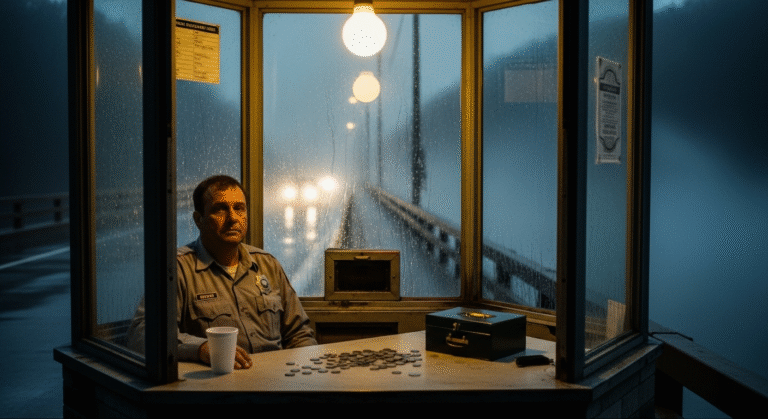
The Toll Booth Operator Night Shift Job at Hollow Creek Bridge
Working night shifts isn’t for everyone. The stillness, the isolation, and the constant hum of the dark can test even the calmest soul. But for those who prefer quiet hours and steady pay, roles like toll booth operator often seem ideal — low traffic, minimal interaction, and a peaceful environment. That’s what I thought when I was assigned to Hollow Creek Bridge, a forgotten stretch of road between two sleepy towns in West Virginia. The offer letter called it a “routine night shift toll position.” What it didn’t mention were the rules — or the stories that every operator before me seemed to whisper about. Section 1: The Job Posting That Sounded Too Easy When I first saw the listing titled “Night Toll Booth Operator Needed – Immediate Hiring”, it felt like a blessing.The job promised: Steady income Minimal supervision Comfortable indoor booth It sounded perfect for someone who’d worked countless night shift jobs before — security posts, parking lot monitoring, late-night customer service. But when I arrived for my first night at Hollow Creek Bridge, the manager handed me a worn piece of paper with three handwritten rules: Rule 1: If a driver hands you wet coins, drop them in the river.Rule 2: Never accept bills after 2:00 AM — they belong to the drowned.Rule 3: If you see headlights with no car attached, step back and look away. At first, I laughed it off. Some old superstition, I thought. Every lonely job has its ghost stories. Section 2: The First Night — Learning the Rhythm Like any night shift position, the first few hours were simple. I logged each passing vehicle, collected tolls, and checked the CCTV feed that covered both ends of the bridge. The air was thick with fog, but otherwise calm. Around 1:45 AM, a silver sedan stopped by. The driver looked normal — middle-aged, polite. He handed me a few coins. They were wet, slick with what I assumed was condensation. Remembering the rule, I tossed them into the metal box instead of my drawer. The next morning, when I counted the collected tolls, those coins were gone. The box was empty. That was my first lesson about Hollow Creek: it doesn’t like to be ignored. Section 3: Isolation and the Weight of Silence Night shift work always teaches patience. You get used to silence — the way it hums between your breaths. But on the bridge, the silence wasn’t peaceful. It watched. Most people imagine a toll booth operator’s night as boring. You sit, you wait, maybe sip some coffee. But the job is more psychological than people think. You start hearing things — footsteps outside, voices from the radio static, or whispers from the intercom that no longer works. In most jobs, noise is a sign of life. At Hollow Creek, noise was a warning. Section 4: The Rules Tested By the third week, fatigue set in. Anyone who’s worked back-to-back night shift jobs knows how sleep deprivation can blur the line between reality and imagination. That’s when the bridge tested me. At exactly 2:07 AM, a black pickup stopped. The driver’s window rolled down, and a pale hand extended a few bills — soaked, cold, and slightly torn. My instincts said “don’t.” My logic said “it’s just rain.” I took the bills. Within seconds, every light on the bridge flickered. The cameras glitched. The temperature dropped so fast my breath froze in the air. When I looked back, the truck was gone — but the money was still in my hand, dripping river water. The next day, my supervisor told me: “Never break the second rule. You’re lucky the river only took your power.” Section 5: What They Don’t Tell You in Job Training No job training manual prepares you for paranormal phenomena. Still, like any responsible worker, I tried to adapt. I documented every incident — the missing coins, the flickering lights, the phantom headlights that appeared without engines. Strangely, management never questioned my reports. It was almost as if they already knew. One old operator once told me during a shift change, “The drowned still pay their tolls, son. Someone has to collect them.” That was when I realized this wasn’t just a job — it was a ritual. Section 6: The Realities of Working the Night Shift From an employment perspective, night shift jobs like toll booth operations demand emotional endurance. You’re alone for hours, managing small repetitive tasks, maintaining safety, and staying alert through long stretches of darkness. Most toll booth operators report struggling with: Fatigue and insomnia Limited social contact High alertness demands Mental isolation But Hollow Creek adds another challenge — spiritual weight. When you clock in here, you’re not just managing traffic. You’re keeping balance between two worlds. Section 7: The Night Everything Changed It was my 40th shift — a stormy Thursday. The rain had been pounding since evening, the bridge slick and reflective like a mirror. Around 3:00 AM, I noticed headlights approaching slowly from the far end. The problem? There was no engine noise. No tires on wet concrete. Just light — hovering, shifting, gliding toward the booth. I remembered Rule 3: “If you see headlights with no car attached, step back and look away.” So I did. I turned my back, shut my eyes, and waited. A cold wind swept through the booth, carrying with it the faint scent of river water. When I opened my eyes, the fog had cleared. But outside the booth window, on the glass, were the marks of five wet fingers. That was the moment I stopped thinking of Hollow Creek as a workplace — and started treating it like sacred ground. Section 8: Why People Still Take the Job Despite its eerie history, the Hollow Creek position remains open every few months. Locals say it’s cursed. But from a job seeker’s view, it’s one of the few steady night shift jobs available in the region. Why do people still apply? Quiet environment Good pay Minimal supervision Rural stability But what they don’t realize is that this job demands something more than skill — it demands respect. The toll isn’t just for travelers. It’s a payment that keeps something beneath the river calm. Section 9: Lessons from the Bridge Working at Hollow Creek taught me lessons no career seminar ever could: Every job has rules for a reason. Sometimes, they protect you from what you can’t see. Isolation reveals truth. The longer you sit in silence, the more you understand what hides behind it. Professionalism isn’t just about routine. It’s about surviving the unseen pressures that come with responsibility. In every profession — from hospital night shifts to late warehouse duties — there are boundaries. Cross them, and something always pushes back. Conclusion: The Bridge Between Worlds When people ask me now about my experience as a toll booth operator, I smile. I tell them it was peaceful — quiet, steady, even beautiful on some nights. But deep down, I know better. Hollow Creek Bridge isn’t just another workplace. It’s a reminder that some jobs test more than your patience — they test your soul. If you ever find yourself applying for a night shift that feels too easy, remember this: every quiet place has a keeper. And every keeper has rules. Break them, and you’ll learn what your paycheck really costs. Night Janitor Job at High School Turns to Terror
