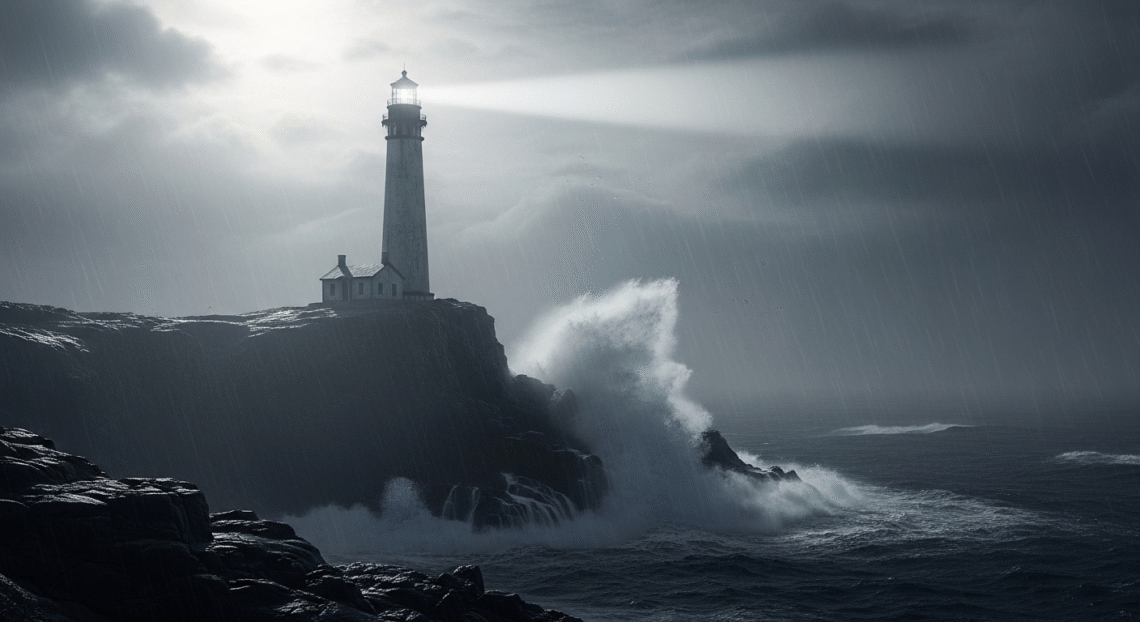
Congratulations — you’ve been assigned to Widow’s Point Lighthouse, a solitary beacon rising from a rocky cliff on the edge of the Atlantic. The wind never stops here. The sea is always restless. And tonight, you’re the only one on duty.
Your orders are simple:
Keep the light burning until dawn.
Stay inside during storms.
And most importantly — follow the rules.
They’re carved into the wood above the supply chest, scratched by the keepers who came before you.
Rule 1: If the sea goes silent, don’t look out the window.
Being a lighthouse keeper means living by the rhythm of the sea. You tend the beacon, record the tides, and keep ships safe from the rocks below. But at Widow’s Point, the ocean doesn’t always behave like an ocean.
Sometimes, it goes completely silent.
No wind. No waves. Just a heavy stillness that presses against the glass. The first time it happens, you’ll think the storm has passed — but it hasn’t.
That silence means something is waiting.
You’ll feel the air shift, like the entire tower is holding its breath. Don’t look out the window. Whatever you see will look back.
One of the old logbooks mentions it:
“The sea went quiet again. I thought I saw the reflection of a ship, but it was above the waterline, not below. Eyes — just eyes — in the waves.”
When the silence comes, keep your gaze on the floor and your hands busy.
Wind the lamp. Check the oil.
Pretend you don’t notice the shadows crawling across the glass.
If you look out, you’ll never stop seeing what’s out there.
The Keeper’s Routine
Every lighthouse job demands precision. You wake before sunset, check the kerosene, clean the lenses, and climb 217 steps to the beacon room. The glass up top bends the moonlight like water, and the metal creaks with every gust.
You record every minute in the logbook: wind speed, tide height, visibility. That’s the part they tell you in training. What they don’t mention is the voices.
Late at night, through the foghorn, you’ll hear faint calls — like someone whispering through static. Some sound like distress signals. Others… sound like your name.
Don’t respond. Even if they sound close. Especially if they sound close.
Rule 2: If you hear knocking from beneath the floor, answer with three taps only.
It usually starts after midnight — faint knocking beneath the wooden floorboards. The pattern is irregular, like someone lost below the tower, trying to signal for help.
You’ll think it’s the tide slapping the rocks, but it isn’t.
The lighthouse stands on solid stone. There’s no hollow space below.
Every keeper hears it eventually. It’s said the first one to ever work Widow’s Point drowned during a storm, dragged beneath by the waves. His body was never found — but his hands, they say, still knock for entry.
When you hear the tapping, don’t ignore it.
Answer with three taps — slow, steady, respectful. That’s how you tell him you’re listening. That you know the rules.
If you tap four times by mistake, the knocking stops for good. But by morning, the tide will bring something to shore — a soaked pair of boots with your name carved inside.
Keep it at three. Always three.
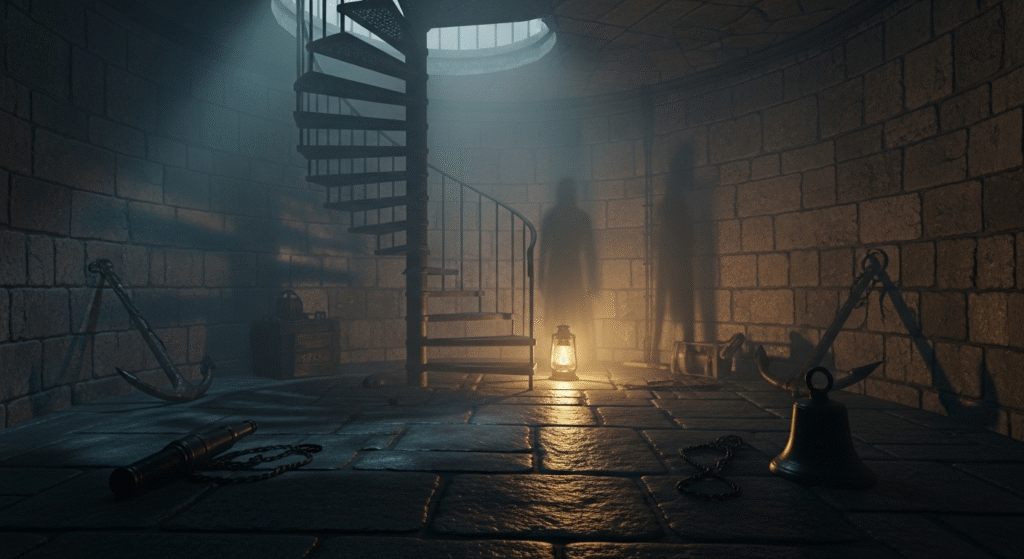
Rule 3: If someone climbs the stairs behind you, never let them reach the top.
The lighthouse staircase spirals upward in a narrow coil of steel and shadow. Every keeper learns to count the steps: 217 from the base to the beacon. You’ll know them by heart after the first week.
But one night, you’ll hear footsteps climbing behind you — slow, heavy, echoing.
You’ll call out. No answer.
You’ll look down. Nothing.
Still, the footsteps keep coming.
Don’t let them reach the top.
Keep climbing faster, or step aside and lock the trapdoor to the beacon chamber.
If the steps stop right behind you, don’t turn around.
The last keeper who did was found at the bottom of the stairs, eyes wide open, mouth full of saltwater.
He’d been dead three days before his body washed up below the cliff. But his logbook showed entries written after that date.
The handwriting wasn’t his.
Widow’s Point: Where the Sea Remembers
Locals call the lighthouse cursed, but that’s not quite true. It isn’t cursed — it’s anchored. Something ancient lives beneath those waves, something that remembers.
They say Widow’s Point was built over a sunken chapel, its steeple still buried in the ocean floor. Every time the beacon turns, the light reflects off something metallic deep below — as if the sea itself blinks.
You’ll see shipwrecks out there, too. Some are centuries old. Some look newer. Sometimes, on a moonless night, you’ll see a ship’s lantern glowing just beyond the fog line — unmoving.
If you check the records, you’ll find it listed as lost in 1899.
And if you ever see it drift closer, turn off the light. It’s not a rescue call — it’s a reflection.
A Keeper’s Isolation
Working alone at a remote lighthouse means no distractions, no company, no sleep that feels real. The sea hums like a heartbeat under the floor, and the fog wraps the tower in a soundproof cocoon.
The isolation starts to eat at you. You’ll find yourself talking to the logs, humming to the waves, naming the gulls that circle the beacon.
But the worst part isn’t the loneliness — it’s the repetition. Each night feels like the same one replayed. You’ll wake to find yesterday’s entry rewritten in your own handwriting, but with different words.
“The sea is quiet again. He’s coming up the stairs.”
The Logbook of the Lost
In the storage chest, beneath the old maps and tools, you’ll find a thick, water-damaged book marked “Incident Reports.”
Every page is a testimony from a previous keeper:
-
1902: “Knocking returned. Replied with three. Calm restored.”
-
1926: “Sea fell silent. Couldn’t resist looking. Now it watches back.”
-
1974: “He’s almost reached the top. Light flickered once. Don’t let him in.”
The last entry, written just weeks before your assignment, reads:
“If someone new finds this — keep the light burning. When it goes out, the sea will remember all our names.”
The page ends there. The rest of the book is blank, though the ink feels wet to the touch.
The Light That Never Sleeps
At 3:03 AM, the beacon will flicker.
You’ll think the bulb is failing, but it isn’t. It’s dimming on purpose.
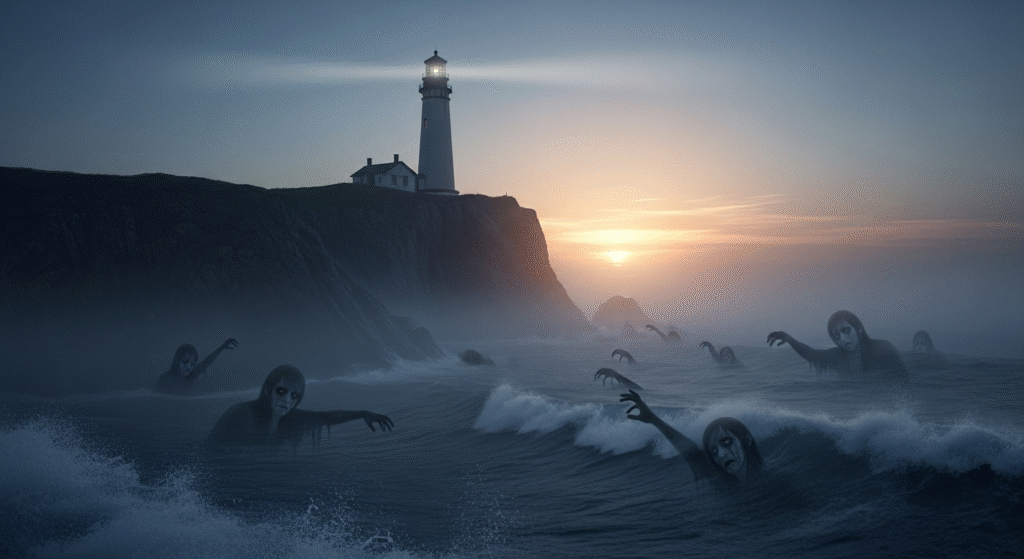
The sea below will shimmer, and for a moment, you’ll see shapes moving in the water — dozens of them, standing upright, pale against the tide. Their faces will look almost human.
They’ll raise their hands toward the light, and one of them will look exactly like you.
If that happens, ring the emergency bell three times and step away from the glass. Don’t stare too long. The reflection isn’t yours anymore.
Official Lighthouse Duties (According to the Maritime Office)
On paper, your lighthouse keeper duties are clear:
-
Maintain the beacon through the night
-
Record weather and tide patterns
-
Respond to distress signals
-
Ensure all equipment remains functional
But at Widow’s Point, there are unwritten responsibilities too:
-
Never let the light die
-
Respect the silence of the sea
-
Keep the rhythm of the waves — or they’ll take it from you
Each of these rules exists for a reason. They’re not superstition. They’re survival.
When Dawn Finally Comes
If you make it to dawn, the light will fade naturally. The first gull will cry, and the ocean will move again. You’ll breathe for the first time in hours.
But don’t celebrate too soon.
At sunrise, go downstairs and check the logbook. You’ll see a new line written at the bottom, in your handwriting, though you didn’t write it:
“Shift complete. Light sustained. Replacement assigned.”
When you go to leave the tower, the door might resist opening.
If it does, it means someone else hasn’t finished their shift yet.
Wait until the knocking stops before you try again.
Conclusion: The Weight of the Light
Being a lighthouse keeper is supposed to be about guidance — about protecting others from the darkness. But at Widow’s Point, the light doesn’t protect you. It keeps the darkness focused. Contained.
Every keeper here learns the same truth:
You don’t keep the light alive — it keeps you.
And when your final night comes, when you hear the stairs creak and the waves whisper your name, remember the rules one last time:
-
Don’t look out.
-
Tap three times.
-
Never let them reach the top.
Because at Widow’s Point, the sea doesn’t forget its keepers.
It just waits for them to return.